

Download Ebook XSL Formatting Objects Developer's Handbook
Delivering the best book for the ideal procedure or problem can be a choice for you that really intend to take or make handle the opportunity. Checking out XSL Formatting Objects Developer's Handbook is a way that will certainly guide to be a much better individual. Even you have actually not yet been a good person; at least discovering how to be much better is a must. In this situation, the problem is out your own. You need something new to encourage your determination actually.
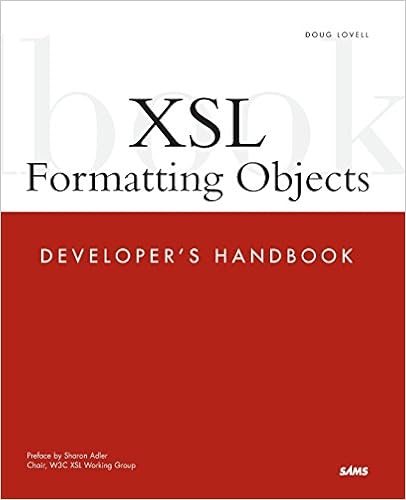
XSL Formatting Objects Developer's Handbook

Download Ebook XSL Formatting Objects Developer's Handbook
Ultimate book collections can be obtained if you constantly visit this web page. Find the countless publications right here. All categories from numerous resources, authors, and writers around the world exist. We not only offer guide collections from inside of this nation. Lots of collected publications are from the outsiders. However, the goals are exact same. They are given as a joined library by internet to give even more valuable sources to obtain guide.
Checking out will certainly not only offer the brand-new knowledge regarding exactly what you have read. Reading will certainly also train you to think open minded, to do wisely, and to get over the dullness. Checking out will be constantly good and significant if the material that we read is additionally an excellent book. As example, XSL Formatting Objects Developer's Handbook is a god publication to review for you. This suggested publication becomes one of the books that will certainly get over a new manufacturer to spend the time carefully.
This is not sort of dull means and task to read the book. This is not sort of tough time to delight in reading book. This is a good time to have a good time by reviewing publication. Besides, by checking out XSL Formatting Objects Developer's Handbook, you could obtain the lessons as well as experiences if you do not have any kind of ideas to do. And what you should get now is not sort of hard point. This is an extremely easy thing, only reviewing.
As understood, easy publication does not suggest straightforward message and impact to get from the book. You may not be able to determine how relevance this XSL Formatting Objects Developer's Handbook is unless you check out and complete it. When somebody really feels that this book is necessary, exactly what about you? Yeah, everyone will have their very own preferred publications. But, that's not fault to attempt checking out other book to enhance the impression and also minds regarding something.
From the Back Cover
"XSL Formatting Objects Developer's Handbook" is a syntactical reference and a guide for developing practical solutions using the complete XSL toolkit. In exploring the available tools and architectures, the book allows programmers to understand and apply XSL as practitioners. XSL-FO is a complex specification that provides a framework for describing detailed document formatting characteristics. A primary goal of XML is to separate the data from presentation. Unlike HTML documents, XML documents contain no information about how those documnets will appear when displayed. The XSL-FO specification provides a standardized way to build stylesheets that express document formatting in pure XML notation.
Read more
About the Author
Doug Lovell taught himself the Basic programming language on a PDP-11 time-sharing terminal when he was a young, impressionable freshman in high school. He saved his programs on punched paper tape, which he rolled up, banded, and stored in tobacco tins supplied by his pipe-smoking mathematics teacher. After becoming a certified flight instructor in Ohio and then moving to New York City to earn a fine arts degree in photography, Doug joined the electronic prepress and digital typesetting facility at Time, Inc. He picked up typesetting and prepress knowledge by working for a few years making Time, Life, Fortune, People, and Sports Illustrated ready for the presses. While working prepress, he partnered in building and operating a business selling graphics tablets for the Commodore Amiga computer; he also wrote a program for animated cartoon drawing, for which he procured his first patent. He left Time to become a resident computer whiz for an engineering firm and to attend graduate school for a degree in computer science. Now Doug works as a software engineer for IBM Research. Typesetting got a grip on him again when he pulled duty to satisfy all the hard-copy requirements of the AutoLoan Exchange project. The project pioneered the process of applying for, approving, and closing automobile loans on the Internet. Doug applied the TeX typesetting language to typeset individualized loan contracts on demand. TeX was most popularly used to typeset mathematics, physics, chemistry, and computer science journals; this may have been the most commercial application of TeX ever undertaken. Doug's most recent program is an implementation of XSL Formatting Objects written with Java. He also has written several tools for working with XML and XSLT, early versions of which appeared on IBM's alphaworks new technologies Web site, and invented TeXML¿an XML vocabulary for expressing TeX typesetting documents. He lives and breathes in the beautiful mid-Hudson Valley of New York, loves to hike the mountaintops, and flies aerobatics wherever he's allowed.
Read more
Product details
Paperback: 456 pages
Publisher: Sams Publishing; 1 edition (November 11, 2002)
Language: English
ISBN-10: 0672322811
ISBN-13: 978-0672322815
Product Dimensions:
7.3 x 1 x 9 inches
Shipping Weight: 1.7 pounds (View shipping rates and policies)
Average Customer Review:
4.2 out of 5 stars
6 customer reviews
Amazon Best Sellers Rank:
#1,602,919 in Books (See Top 100 in Books)
Before I jump into an overview of the book, I wanted to make a quick observation first. I personally can't understand why XSL-FO hasn't caught on as fast as XSLT, XML and its ultra popular variant HTML. XSL-FO is the third spec of the original big three specs provided by the W3C and it was supposed to provide a markup language suited specifically to printing documents. XSL-FO is to the printed page what HTML is to the browser.This is one of three books currently available on the XSL-FO topic, and I am shocked at the lack of availability of good books on the topic. This is the first book I read on XSL-FO and I have to say it does a good job of introducing the language and it's concepts. It is a semi good reference book. However, the code samples I think are just horrible. There is not a single examples where you have simple straight XSL-FO. All code examples are FO interlined with XSLT, making the syntax confusing and almost unreadable. You have to sift through 2 pages of XSLT before you get to one XSL-FO element. I think part of the slow acceptance of the language has to do with the fact that all books on the topic present code that mixes FO and XSLT. You can write straight workable XSL-FO that is much easier to debug and understand, than the code presented in this book.Also the renderer software that was recommended in the book are the oldest guys on the market, but definitely not the best. Antenna House is the big dog and they have an excellent renderer (they are very expensive though). Some of the other renderers mentioned in the book are just terrible. If you want a list of good renderes search online. On the Windows platform, in my opinion, the best two renders for high volume operations on the market are Antenna House and the Ibex PDF Creator (from xmlpdf.com)A good book that gives XSL-FO only code samples is the Ken Holman "Definitive XSL-FO" book. That book is a more advanced book however, and is only good if you already understand the language. It is also a semi-good reference book. To a novice, that book will be a bit over the top and probably very confusing. The other good book on the market is the O'Reilly book. Of the three, it is the best reference book by far.So to recap, if you are venturing into XSL-FO, buy Doug Lovell's book in the beginning. Then buy the Dave Pawson book for reference. And finally when you get some mileage under your belt, get the Ken Holman book for the more advanced concepts and topics.
Older book, but still a great reference on XSL-FO. Not a lot to choose from out there. It has helped me a lot to understand and use XSL-FO better.
Plenty of information in this book, but with the predominance of MSXML it is practically useless as XSL-FO is blocked by default and can't be opened up. If you were to use another XSL processor then this would be a good book to have.
I really enjoyed reading this book. The author writes clearly and succinctly, focusing on potential points of confusion. His brief explanation of how XSL works in Appendix A is the best I've ever seen -- short, but clear and explanatory. So much technical writing these days involves just regurgitating online references; this book is much better than that, and highly recommended for someone starting out in XSL-FO. That said, there are a number of serious errors; e.g. Figures 8.1 and 8.2 on pp. 124-125 are reversed, and several of the examples contain typos which will confuse new users. This book was published well over a decade ago; a new edition or new printings should have corrected these issues years ago. Presumably we can blame the publisher for this. Also, this book only covers XSL-FO version 1.0. A number of important changes have been introduced in version 1.1.Nevertheless, there continue to be only 2 books in print in the English language covering XSL-FO; this one, and the O'Reilly title by Pawson, which is similarly out of date and contains many more errors than this one. I suggest reading both and then going to the W3C standard for further information. Like another reviewer, I'm mystified why XSL-FO hasn't gained more traction in the technical world; I find it indispensable for most publishing projects involving recurring editions for which PDF output is preferred/required.
I rated the book 4 stars because it provides solid examples in many areas of XSL FO that actually work. Even though the W3C recommendation has been out since October, 2001, we have just started to see accessible books on XSL FO, and this is the best. The author provides a hands-on view and gives you examples that work and get you up and going quickly. Not a lot of wading through esoterica wondering how you would even get started with a simple document.However, that is not to say that the book is without problems. Let me list them in order:1. Software that will format XSL FO is in its infancy. Therefore, although the examples work, you have to burn some shoe leather finding software that is compliant with the spec. It would have been better if the author had bundled an evaluation copy of either the Antenna House software which he claimed would format *almost* all of the examples or his own XFC software that he developed for IBM alphaworks. I did download the XFC software, but although written in Java, it is very much oriented towards a windows platform, and I could not concoct a way to get it to run on my linux machine (I gave up after discovering I had a non-compliant version of the xerces package). I think one of the reasons Michael Kay's Wrox XSLT book has been so popular has been because of his work on Saxon. Software would have made this book a 5 star book.2. Downloadable examples. These were not available at first, but the author had them up within a week of my email, correcting an error on the publisher's web page. So, this went from a problem to a plus.3. Pagination (Chapter 8) is not very clear. Some of the figure references seem to have been reversed (generally, in many places where the author refers to figure 8.1 you should read 8.2 and vice versa). This chapter needed a concrete example to start. Then the author could have gotten into the more esoteric issue of overlapping regions.
I have just started working with XSLT and XSL-FO. This is an excellent book that explains all of this stuff in a language that you can understand. I would definitely recommend this book if you are new at this stuff.It also has an excellent appendixes with the listing of all of the objects and properties.
XSL Formatting Objects Developer's Handbook PDF
XSL Formatting Objects Developer's Handbook EPub
XSL Formatting Objects Developer's Handbook Doc
XSL Formatting Objects Developer's Handbook iBooks
XSL Formatting Objects Developer's Handbook rtf
XSL Formatting Objects Developer's Handbook Mobipocket
XSL Formatting Objects Developer's Handbook Kindle


 Hello, my name is Jack Sparrow. I'm a 50 year old self-employed Pirate from the Caribbean.
Tidak ada komentar:
Posting Komentar