

Ebook Free The Many Faces of Evil (Revised and Expanded Edition): Theological Systems and the Problems of Evil, by John S. Feinberg
The factor of why you could obtain as well as get this The Many Faces Of Evil (Revised And Expanded Edition): Theological Systems And The Problems Of Evil, By John S. Feinberg quicker is that this is guide in soft documents type. You could check out guides The Many Faces Of Evil (Revised And Expanded Edition): Theological Systems And The Problems Of Evil, By John S. Feinberg wherever you desire also you remain in the bus, office, house, and also other places. But, you might not should move or bring guide The Many Faces Of Evil (Revised And Expanded Edition): Theological Systems And The Problems Of Evil, By John S. Feinberg print any place you go. So, you won't have much heavier bag to bring. This is why your option making far better principle of reading The Many Faces Of Evil (Revised And Expanded Edition): Theological Systems And The Problems Of Evil, By John S. Feinberg is really valuable from this instance.
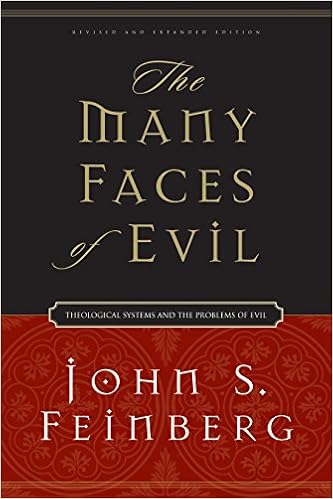
The Many Faces of Evil (Revised and Expanded Edition): Theological Systems and the Problems of Evil, by John S. Feinberg

Ebook Free The Many Faces of Evil (Revised and Expanded Edition): Theological Systems and the Problems of Evil, by John S. Feinberg
Discovering one publication to be the precise publication to read from countless books on the planet is at some time baffling. You may should open up as well as browse often times. And also currently, when finding this The Many Faces Of Evil (Revised And Expanded Edition): Theological Systems And The Problems Of Evil, By John S. Feinberg as exactly what you really desire, it's like finding oasis in the treat. Actually, it is not regarding the author of this publication or where this publication originates from. Often you will require this book due to the fact that you actually have the obligation to get or have the book.
The factor of why you can receive as well as get this The Many Faces Of Evil (Revised And Expanded Edition): Theological Systems And The Problems Of Evil, By John S. Feinberg faster is that this is guide in soft file kind. You could review guides The Many Faces Of Evil (Revised And Expanded Edition): Theological Systems And The Problems Of Evil, By John S. Feinberg wherever you desire even you are in the bus, workplace, residence, as well as other places. Yet, you might not need to move or bring guide The Many Faces Of Evil (Revised And Expanded Edition): Theological Systems And The Problems Of Evil, By John S. Feinberg print anywhere you go. So, you will not have heavier bag to bring. This is why your option to make better concept of reading The Many Faces Of Evil (Revised And Expanded Edition): Theological Systems And The Problems Of Evil, By John S. Feinberg is truly valuable from this case.
Reading will not make you always imaging and also fantasizing about something. It needs to be the manner that will certainly buy you to feel so smart as well as wise to undergo this life. Also reading might be dull, it will certainly depend upon guide kind. You could pick The Many Faces Of Evil (Revised And Expanded Edition): Theological Systems And The Problems Of Evil, By John S. Feinberg that will not make you really feel bored. Yeah, this is not kin of enjoyable publication or spoof book. This is a book where each word will offer you deep meaning, yet very easy and also basic uttered.
you are not sort of ideal individual, yet you are a good person that always attempts to be much better. This is among the lessons to obtain after reading The Many Faces Of Evil (Revised And Expanded Edition): Theological Systems And The Problems Of Evil, By John S. Feinberg Checking out will certainly not make you really feel lazy. It will certainly make you a lot more thorough to undertake your life as well as your responsibilities. To check out guide, you could not need to compel it entirely completed in short time. Obtain the soft data as well as you could manage when you want to start checking out when you will certainly finish this book to check out.
Review
"Feinberg's classic treatment of the problem of evil has been a standard treatment of this philosophical issue for some time. Coming from the Augustinian/Reformed tradition, it is a vigorous defense of both God's sovereignty and human responsibility. This new edition makes an already great book even better, as Feinberg has been able to incorporate new material in his debates and conversation with people like Rowe and Plantinga. This is surely one of the most important books ever written on the problem of evil. Those who ignore it will find their own understanding of the issue impoverished, especially in light of the current discussion."―Chad Owen Brand, Associate Professor of Christian Theology, The Southern Baptist Theological Seminary"The Many Faces of Evil presents an excellent overview and response to the logical, evidential, and existential aspects of the problem. Those who expect insightful, decisive analyses from John Feinberg will not be disappointed. Crossway Books is also to be commended for its ongoing tradition of strong scholarly publications. This is a 'must read' text."―Gary R. Habermas, Distinguished Research Professor and Chair, Department of Philosophy, Liberty University"In this updated edition, Feinberg continues to press home the message that there are many versions of the problem of evil and that, in fact, there are many successful solutions to these versions as well. Feinberg gives a thorough presentation of the alternatives as well as of his own position. A valuable resource!"―Winfried Corduan, Professor of Philosophy and Religion, Taylor University"This latest edition of The Many Faces of Evil is a gem. It provides extensive analyses of various statements of the problem of evil as well as responses that can be offered from a variety of Christian perspectives. Feinberg shows that both the problem and the response to the problem will vary, depending on one's understanding of God and of evil. His own position is offered in dialogue with major classic and contemporary discussions of the problem of evil."―Ronald J. Feenstra, Director of Doctoral Studies, Calvin Theological Seminary"The Many Faces of Evil is a thorough, clear, and highly competent treatment of a perennial problem. At times, it is painful and moving to read. All of us can learn much from it."―Keith E. Yandell, Julius R. Weinberg Professor of Philosophy, Emeritus, University of Wisconsin Madison
Read more
About the Author
John S. Feinberg (PhD, University of Chicago) is department chair and professor of biblical and systematic theology at Trinity Evangelical Divinity School. He is the author of Ethics for a Brave New World (with Paul D. Feinberg) and is general editor of Crossway’s Foundations of Evangelical Theology series.
Read more
Product details
Paperback: 544 pages
Publisher: Crossway; Revised and Expanded ed. edition (May 6, 2004)
Language: English
ISBN-10: 1581345674
ISBN-13: 978-1581345674
Product Dimensions:
6 x 1.1 x 9 inches
Shipping Weight: 2 pounds (View shipping rates and policies)
Average Customer Review:
4.7 out of 5 stars
17 customer reviews
Amazon Best Sellers Rank:
#357,687 in Books (See Top 100 in Books)
Feinberg’s ground breaking book called “The Many Faces of Evil: Theological Systems and the Problem of Evil,†is a book in which Feinberg excavates profoundly deep in explicating the problem of evil, and the differing systems that are widely credited and utilized as a series of defenses or theodicies pertaining towards the problem of evil that is presented by the atheists today in the contemporary world. There is a story about two brothers that has sold almost all they had to go into the fad of gold mining. They sold enough to generate the income to buy equipment for the mining, as well as the workers they have hired to help them. They even bought a certain land to start excavating for gold at a certain mine. For a long time, they have found minimal results. They have found some gold here and there, but did not really “strike gold†in that prolific sense to say they have truly succeeded and made it worth it to go through all the troubles and investments they had incurred. When minimal results were found, they were losing more than making more, which meant they were going bankrupt. They eventually sold it to a general prospector, and that prospector had gotten advice whether or not this place has the potentiality to bring forth much gold. The advice that was given was deemed to be trustworthy to this common prospector and he eventually bought the land, as well as all the equipment from the brothers for a couple hundred bucks. The general prospector had dug a few feet deeper from where the two brothers left off, and they have found the most amount of gold that anybody would ever find. Had the brothers mined a bit deeper, they would have received a great amount of gold. The reason I bring up that illustration is to propose that John Feinberg is that philosopher that went not only a few feet deeper, but dug a monumentally deeper amount and have struck much gold where others may have left off at a general rate of digging. In this review, I will be proffering a book critique of his book and will be explicating a very brief summary (the book is over 500 pages), and my own assessment of the strengths of the author’s thesis in whether or not he supports it well with strong arguments, and my own brief critique of Feinberg’s personal defense of his book. Feinberg’s own purpose of his magisterial book on the problem of evil is to show that there are a myriad of theologies that defend the many problems of evil. However, his goal is not to state that his own theodicy is the right one, nor is he trying to make a positive case that God exists. He is simply attempting to show that God’s omnipotence and benevolence can coexist with evil and there are many different defenses and theodicies to deal with them. He states:“Suffice it to say that the burden of this book isn’t to defend my conception of God as the correct one; I have done so elsewhere. Rather, my purpose in this book is to show that many different theologies committed to divine omnipotence and benevolence can solve the many problems evil poses for them .â€So, this is why he speaks on to address a multifarious amount of theodicies and defenses to show that the problem of evil can be solved. He does show forth the ones in which he believes does not solve it, such as the Theonomy Defense. Before addressing his book, Feinberg puts as preliminary thesis points that he wants to bring forth before explicating on the myriad of defenses and theodicies to solve the problem of evil. Here are the seven theses he states : 1) the traditional understanding of the nature of the problem of evil considers it to be only one problem that attacks all theological positions in precisely the same way but it is mistaken, (2) since the problem of evil in its logical form is about the internal consistency of God and evil coexisting, anyone who attempts to discuss a logical problem of evil must relate it to a particular theology of that system’s accounts of God and evil, (3) there are many forms of theism that can solve the logical problem of evil, (4) evil’s existence also poses an evidential problem that many theistic systems can resolve, (5) many theologies can solve the problem of evil but it incorporates theological and/or philosophical commitments Feinberg finds unacceptable, (6) one of the most challenging problems of evil for theists is the problem of hell, and (7) the religious problem of evil is a different kind of problem of evil from the rest and requires a different treatment. Feinberg does resolve all of these theses throughout the outset of his book. Within his book, there are four major sections that answers these theses he presented in his introduction. They are (1) the logical problem of evil, (2) the evidential problem of evil, (3) the problem of hell, and (4) the religious problem of evil. Within his first section, he propounds to exposit the theist’s theodicies and defenses. Here are the major ones that he proposes and explains, as well as putting his own personal assessment on it: (1) Theonomy Defense, (2) Leibniz’s Theodicy, (3) Free Will Defense, (4) Schlesinger’s Defense, (5) Greater Good Defense, (6) John Hick’s Soul-building Theodicy, (7) Marilyn Adams’s Christian Solution, and (8) Feinberg’s defense. The limited space for this book critique constrains me to go over all of these theodicies/defenses, but I will be going over one of them, which is the Leibniz’s Theodicy.For the Liebniz’s Theodicy, Leibniz proposes a theodicy in which he believed that God operates with sufficient reason, and if God is all-wise, God cannot do something that is foolish . There are many possible worlds that could have been the case, in which he believed there were infinite possible worlds of how our world could have been. A possible world is a state of affairs of how our world could have been, given that there are no logically contradictory. For instance, since it’s impossible for a person to be a married bachelor in any possible world, since it’s contradictory. Since God is all-knowing, God would know which possible world would be possible. Since God is all-wise, God would know which possible world is the best possible world for us. Since God is all-powerful, God would have the power to actualize the possible world into an actual world. Since God is all-good, he would only want to create the best possible world for us. Since this is the actual world right now, and it also includes evil, God deemed it right in His eyes to see that this is the best possible world with a world that has evil. Thus, God has justifiable moral reasons for why this world is what it is. For God to not make the best world would be morally reprehensible of God. For Feinberg’s next sections, I will explain them in a very brief fashion. Feinberg’s section two is about the evidential problem of evil. This was the problem of evil where it was inductive and that the most the atheist can show from the inductive argument like this is to show that it is highly improbable that God exists given the evil in the world. He brings up many objections towards the theist’s side, as well as the other differing theodicies and defenses to show forth why the evidential problem of evil does not work. For the sake of brevity, I will be explaining only Richard Swinburne’s defense in solving the evidential problem of evil. He believed that natural evil is logically necessary if agents are to have the knowledge of how to bring about evil or prevent its occurrence . Swinburne believed that it would be difficult to have knowledge of whether certain actions would bring pleasant results or unpleasant results, had not evil been present. Here is the key thing for Swinburne: Without the instance of evil in others or in history, there would be no knowledge of how to inflict or avoid that evil. For example, we know that cyanide is poisonous to humans because of past experiences of someone being poisoned by one. There must be also natural evils occurring if men are to know themselves on what causes evils or how to prevent them. He gives another example of city planners. How will the city planners know whether to build a city on areas prone to earthquakes for in areas not subject to such earthquakes? They can’t know until it actually has occurred in that part of the city which has been observed . For Swinburne, this knowledge is important and becomes a morally justifiable reason for God to permit evil because when people have free will, they will have genuine choices to do good or evil. But if we know these events, we can know the certain consequences of evil and know how to prevent them. For section three, Feinberg addresses the problem of hell. He talks about the major core doctrines concerning hell from the Scriptures. He presents the problem of hell, which is that if God is omnipotent and omnibenevolent, there would be no hell, but yet, hell exists. He speaks of certain options the theist can take: (1) one can modify their view of God, (2) change the system’s conception of ethics, (3) propose the doctrine of universalism in that nobody goes to hell, and (4) keep the traditional and orthodox position of hell intact, but explain God’s morally sufficient reason for implementing such a system. In section 4, he speaks of the religious problem of hell, and offers pastoral counseling and Scriptural encouragements in dealing with the emotional problem of hell. As for my own personal assessments on Feinberg’s book, as to whether or not he strongly supported his theses and his main purpose of the book, he did a fantastic job. His main job was to present differing theodicies and defenses, and show that there are good arguments to solve the issue of the problem of evil in its many forms. He offered various philosophers and theologians to defend the logical problem of evil, and I believe he offered sound critiques for each of the views. Furthermore, Feinberg did an excellent job in refuting or finding some difficulties of certain theodicies or defenses, in which it really did make a lot of sense. Sometimes, I do think that Feinberg goes a bit overboard with his objections, because it becomes extremely clear that he is just simply biased with his own position of a nonconsequentialist ethics, as well as his compatibilistic account of free will. However, because of this, he does bring into some certain legitimate difficulties of certain views. For instance, one of them happens to be his objections towards John Hick’s Soul-Building Theodicy. When I read the original article by John Hick in him ascertaining the logical necessity of evil for the building of souls or character, I thought he had an air tight argument. Although I disagreed with Hick’s universalism, for I am convinced this is not biblical or found in the Scriptures at all, since the Bible seems extremely clear that there is no other name under heaven in which one can be saved (Acts 4:12), and that whoever believes in Jesus is the one that has eternal life (John 3:16), and whoever doesn’t believe is condemned for all have sinned (Romans 3:23). However, putting all that aside, I thought that Hick’s theodicy was extremely air tight, until Feinberg enlightens his readers with the difficulty of Hick’s theodicy, in that one can actually build character and souls without logically having evil as a necessary thing. To say that evil is logically necessary before building souls doesn’t seem persuasive to Feinberg since many people can build virtue without the evils in this world. Feinberg states:“Central to the soul-building theodicy are the notions that the purpose of our world is to build souls and that evil is necessary for that project. It is that latter claim that I find especially problematic. I can state my objections in the form of two questions. First, must there be difficulties to overcome in order for us to learn to love God? I don’t see that the only way God has for building souls is through difficulties .†There are many other objections that he brings up well, but I do have to admit that many of them have to do with not necessarily the defense or theodicy per se, but he rejects it because of his compatibilistic account of free will, and his nonconsequentialist ethics. I do think that Feinberg did an excellent job in explaining the problem of hell. His doctrine of hell was extremely biblical and I had to simply admire how he was able to wrestle with this difficult doctrine while not capitulating on his view of God or resorting to universalism or annihilation. He admitted that these are the things that are the facts pertaining to the doctrine of hell, and how there was a morally justifiable reason why God allowed or permitted hell to exist.As for Feinberg’s defense, I would like to comment on that for my last assessment. Feinberg argues this for his defense:“God can remove evil if that is all he wants to do in our world. However, he can’t remove evil without 1) contradicting other valuable things he has decided to do, 2) casting doubts on or directly contradicting the claims that he has all the attributes predicated of him in Scripture, and/or 3) performing actions which we would neither desire nor require him to do, because they would produce a greater evil than we already have in our world. Of course, if I can point to some valuable aspect of our world and show that God couldn’t both put it into our world and at the same time remove evil without one or all of 1)-3) happening, then I shall have shown that ours is one of the good worlds God could have created, in spite of the evil in it .†He goes on to say that for God to remove evil, there are eight different ways, in which all have inherent problems that are either far more detrimental to have as a result or it contradicts one of Feinberg’s three criteria . His defense is quite strong, is biblical, stays true to his Calvinistic core beliefs, and it doesn’t compromise God’s attributes or what the Scripture has to say about him. One of the few weaknesses of his defense is that I do not think he is adequate in explaining sin. He seems to only say that our own desires are what creates it. However, in the Scripture, it does talk about the “Evil One†or the “devil†actually causing that desire in us or agitating it in a strong way, in which if it wasn’t for him, it wouldn’t be as likely to sin. For instance, Adam and Eve never sinned or had the desire to sin or disobey God until the serpent came and tempted Eve into getting her to eat the apple. So, although acting on the desire is what causes sin, there are other factors that agitate or tempt us to sin other than just merely our own desires. Furthermore, he forgets to mention that God will rid the evil in one sense in this world because in the millennium, some theists believe that the devil will be put in a pit that is locked away, and it will be sealed for a thousand years so that he can deceive the nations no more (Rev. 20:1-3). Moreover, I think that another weakness that John Feinberg has for his defense is that it is not necessarily faulty per se, and it does answer the problem of evil, but it is extremely difficult, and arduous for a teacher to explain this to an average layman. This doesn’t seem to be the defense that a Christian may want to use for debates, evangelistic purposes, or to teach an average lay person in a church Sunday school so that they can utilize it when defending the faith. Something like Richard Swinburne’s defense, or Alvin Plantinga’s Free-Will Defense seems to be easier to understand and utilize for practical use. In conclusion, I have given an overall book critique of John Feinberg’s book. I have shown what his purpose was, in which it was to show that there are many theistic theodicies and defenses to answer the problem of evil. Moreover, I have given an overall view of his preliminary theses, and the differing sections that Feinberg has. Moreover, I have given my personal assessment to Feinberg’s book, as well as his own defense. Feinberg has written more than just a book, but a magisterial book on the problem of evil in which not many books can compare or compete to be in his caliber in today’s times.
John Feinberg has written an incredible work in The Many Faces of Evil. His research and his attentive approach are to be admired, even if one disagrees with him at every point of his theological system. I find that my own theological positions were bolstered and refined by Feinberg’s thorough address.Generally, Feinberg states his goal as that of refuting a particular atheistic assertion concerning the theist’s problem of evil. In the text, J. L. Mackie is the champion of the allegation that is the primary target of Feinberg’s refutation, but there are others who share Mackie’s common atheistic opposition to theism. Feinberg wrote, “Mackie believed the traditional problem of evil deals a devastating blow to all theistic positions committed to God’s omnipotence and benevolence and evil’s existence… [Mackie] maintained to the end that the existence of evil poses an unresolvable problem for traditional theism. I believe these claims are mistaken and that it is possible to demonstrate so. That is the major burden of this book.†From this launching pad, Feinberg sets numerous artillery shells to flight in a direct assault on Mackie’s claim.Feinberg, it seems to me, did a fine job of logically presenting his own goal and that of any theist who seeks to defend his or her position against such an attack. He made clear, the “theistic defender need only show a possible way for the various propositions held to be true. Hence, theists need not claim to have the explanation as to why an omnipotent, all-loving God would allow evil. They need only offer a possible explanation†(italics added). In stating the task in these terms, Feinberg shifts the theist’s burden from impossible (after all, God has only answered this question with a mysterious thundering – for His good pleasure) to achievable.
Get it, very insight to the problem of evil in philosophy of religion.
Thx
This book was such of an enlightening experience for me. I also had the pleasure of having the author as one of my professor in an Ethnic Class.
Comprehensive survey of philosophical/theological consideration of the conundrum, "If God is good and all powerful, why evil?". While the author admits his Calvinistic beliefs limit his view of free will, he presents other's views openly and fairly. Good survey, although the subject and arguments are difficult to follow sometimes.
This is a serious and challenging book. The author gives an exhaustive account of the main theories regarding theodicy (the problem of the existence of evil in the universe). He separates theology from philosophy/logic and parses the arguments so carefully that it can be exhausting at times to read. Nonetheless, if you are interested in the topic, it is well worth the effort to follow and understand. Although he approaches the topic from a Christian vantage point, he does a very good job of presenting and discussing the viewpoints of prominent atheist critics.I've augmented my reading by a book about the Dalai Lama, which shows that the Buddhist theological perspective is quite different, yet the Dalai Lama is great friends with, for example, Bishop Desmond Tutu and (past tense) Pope John Paul II. Also, the Transcendentalists were greatly influenced by Hindu and Buddhist thought, and the view that "what goes around comes around" has found favor with many people in our own time. Why evil exists is a more complicated problem, perhaps.
This book covers it all. Whether you are an Armenian or a Calvinist, this book will answer your questions. I recommend it highly.
The Many Faces of Evil (Revised and Expanded Edition): Theological Systems and the Problems of Evil, by John S. Feinberg PDF
The Many Faces of Evil (Revised and Expanded Edition): Theological Systems and the Problems of Evil, by John S. Feinberg EPub
The Many Faces of Evil (Revised and Expanded Edition): Theological Systems and the Problems of Evil, by John S. Feinberg Doc
The Many Faces of Evil (Revised and Expanded Edition): Theological Systems and the Problems of Evil, by John S. Feinberg iBooks
The Many Faces of Evil (Revised and Expanded Edition): Theological Systems and the Problems of Evil, by John S. Feinberg rtf
The Many Faces of Evil (Revised and Expanded Edition): Theological Systems and the Problems of Evil, by John S. Feinberg Mobipocket
The Many Faces of Evil (Revised and Expanded Edition): Theological Systems and the Problems of Evil, by John S. Feinberg Kindle


 Hello, my name is Jack Sparrow. I'm a 50 year old self-employed Pirate from the Caribbean.
Tidak ada komentar:
Posting Komentar